What is a Lippitt Morgan?
A Morgan whose every pedigree line runs back to twenty-five old-Vermont foundation animals — and the last family in the breed still built, moving, and thinking like the horse Justin Morgan was.
Defined by blood, verified by DNA.
A Lippitt Morgan is a registered Morgan horse whose entire pedigree — every line, every generation — traces to twenty-five foundation animals: eight stallions and seventeen mares of concentrated old Vermont breeding, each chosen for the closest possible cross to the cornerstone sire, Peters’ Ethan Allen 2d 406.
That closed book has a consequence no other Morgan family can claim: the Lippitt is the only strain within the breed set apart by its own DNA definition. A horse is a Lippitt by what is in its blood, not by whose logo is on its papers — and a genetics laboratory can verify it. Foreign blood is not seen in the Lippitt population, kept out by generations of breeders who believed the Morgan should stay Morgan.
Fewer than 2,000 Lippitts are alive today. Each one is a working archive of the original American horse.
Read him from the ground up.
Condensed from Standard to Preserve the Original Type by Bruce Orser — the registry’s working description of the true type, drawn from period accounts of Justin Morgan and his sons. The full standard is in the library.
“You could hang your hat on his eye.”said of Figure, by a man who knew him
- Height & weight
- About 14.2½ hands and 975 pounds. “The best type is associated with the smaller individual” (Dr. C. D. Parks). A Morgan over 15.1 usually lacks many of the breed characteristics.
- Head
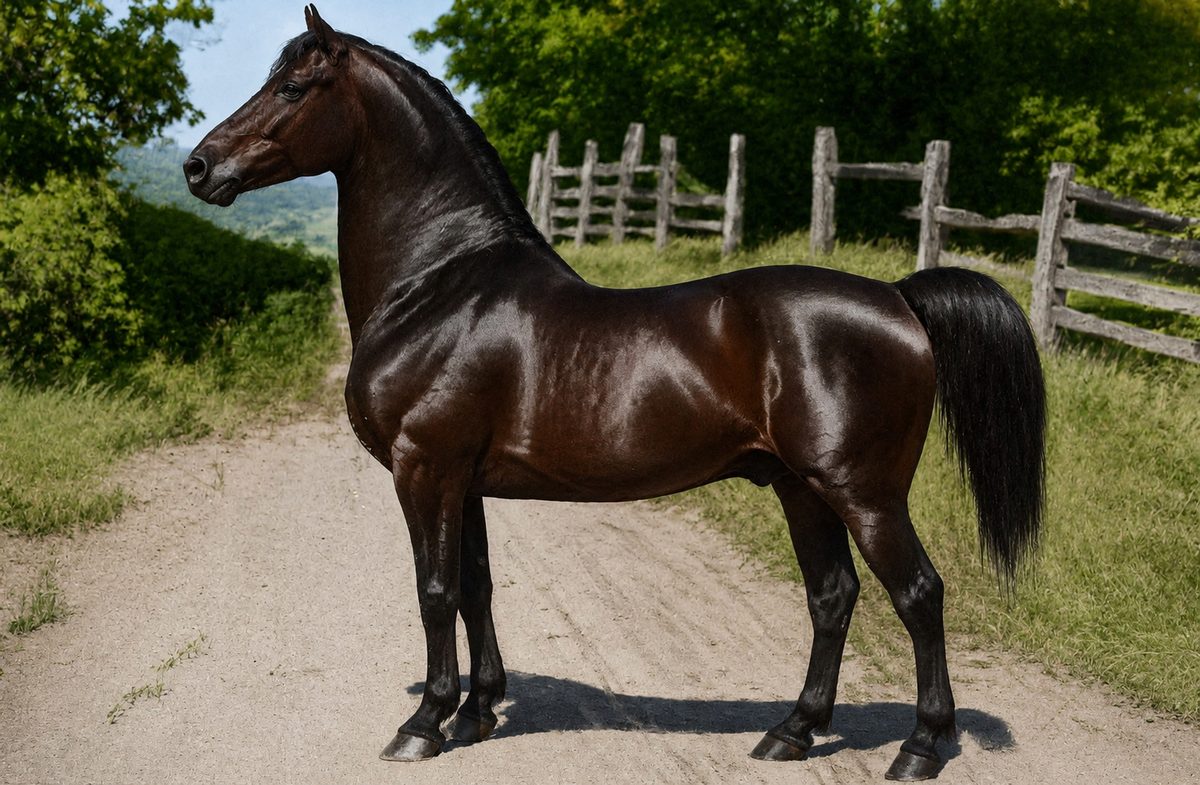
- Small to medium, finely made and lean; deep, wide jowl tapering to a small, clean-cut muzzle; large open nostril. The eye large, prominent, and set wide — bright, bold, and kind by turns.
- Neck
- Wide at the base, high and full in the crest (knife-fine in the mare), carried naturally upright — and set on top of the shoulders, not in front of them. The high head carriage is inherited, not gadget-made.
- Shoulder & chest
- Heavily muscled, deep, extremely long and oblique. Chest well spread and deep, with the breast bone protruding — a mark of the early Morgans. Front legs set wide, never “coming out of the same hole.”
- Back & loin
- Short, broad, and muscular, with wide, strong coupling — very little space between the last rib and the hip. The body is long underneath because the shoulder is long, while the back stays short.
- Hindquarter
- Round from the side and from behind: hip well forward, thigh heavily muscled, stifle low and forward, croup long and gently sloping to a well-set tail. The engine of the horse.
- Legs & feet
- Short legs — shorter than in other breeds — with long, muscular forearms and short cannons, wide and flat as viewed from the side, clean and free of meat. Pasterns short to medium. Hoof small to medium, dense and hard, not inclined to chip or crack.
- Mane & tail
- Full and heavy, straight or wavy, never short or sparse. Tail set neither high nor low, carried well out from the dock.
- Color
- Chestnut, bay, brown, black.
- Constitution
- Great bone and muscle for his size; intelligence of the highest order; kindness to match; and the famous nerve force — see below.
“Trappy” — the trot that built New England.
Lippitt movement is its own signature. The stride is short, quick, and elastic — the accent on the flexion of the pasterns, not the exaggerated knee and hock action borrowed from Saddlebreds and Hackneys. The feet land flat and do not linger; the walk is fast and businesslike; the trot is low, smooth, ground-covering, and square. Old horsemen called such horses “daisy clippers,” and the word that keeps appearing in the record is trappy: rapid, determined, sure-footed going with obvious play in the muscles.
Strong muscle acting on short bone is the whole mechanical secret. It is why the same horse could out-walk, out-trot, and out-pull the long-striders — and why Linsley answered the critics who complained the Morgan “takes too many steps in a mile” the way he did:
“It is because they take more steps in a mile than the long-strided horse that the Morgans so easily leave them behind before nightfall… Short steps come from short legs, and short legs are indispensable.”
D. C. Linsley, Morgan Horses“A Morgan glides away at eight or nine miles in an hour, with an easy and eager movement, as if his legs felt best when so employed.”
Spirit of the Times, January 1842Nerve force: all that fire, and a child on his back.
The early writers reached for a special term for the Morgan’s constitution: nerve force. It meant a nervous system of the very highest order — ceaseless, eager, animated energy — governed by an intelligence and a kindness that made all that fire perfectly usable. Justin Morgan carried the Commander-in-Chief at military review “displaying all the fire and pride imaginable,” and a lady could drive him to a dance the same evening.
That double inheritance — at once animated and docile — is the trait Lippitt breeders guard most jealously, because it is what the horse is for. A Morgan without it, the old breeders said, is a horse that only looks like a Morgan. The proof has always been photographic: for as long as cameras have pointed at these families, the family stallion has been packing the smallest member of the household.
“He was nearly perfect in conformation, but it was to the immense amount of nerve power that was attributed his all-around ability.”
on Justin Morgan — New York Evening Sun, February 1908
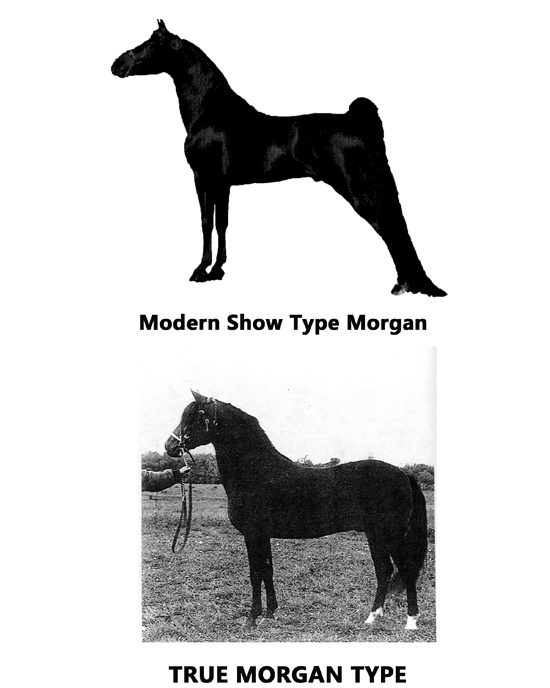
Lippitt versus the modern show Morgan.
Both are registered Morgans. They are not the same horse, and a buyer deserves to know it before writing a check.
The Morgan began as one recognizable animal — so uniform that a breeder with a good eye could pick one out across a fairground. Over the last century much of the breed was redirected toward the show ring: taller frames, longer backs and legs, longer necks brought up out of the front of the shoulder, and high, snapping knee action of the kind admired in Saddlebreds and Hackneys. Judged as show horses they are often magnificent. Judged against Linsley’s Morgan, they are something new.
The Lippitt population was never redirected. The frame stayed low and round; the back stayed short (a study of Morgans at Middlebury found the old five-lumbar short-coupling still present in the Lippitt nucleus); the action stayed flat, quick, and useful; and the mind stayed a working horse’s mind. When the registry says the Lippitt is the original Morgan, that is not sentimentality — it is a conformation chart you can check point by point, and a DNA record you can test.
“Never display your ignorance in speaking of a Morgan horse by mentioning size, as that is the thing he does not possess.”
Amasa Bemis, old-time Morgan breeder
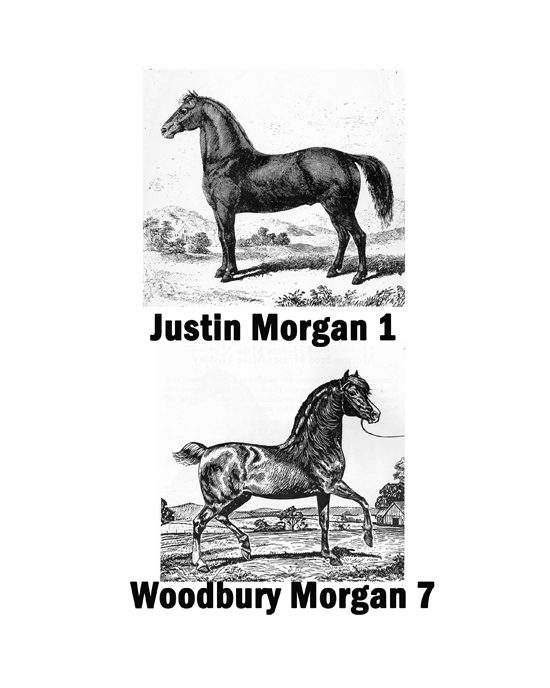
More plates — the “Long & Low” series comparing Morgan and Thoroughbred proportions — are in the education library.
Whatever the day asks.
Reining titles at the Grand National. Combined driving championships. Competitive trail, dressage, hunt seat, halter, 4-H, and the family trail string — today’s Lippitts do all of it, usually several of it, because a general-purpose horse was always the point.
What to look for when you go to see one.
Type first, then quality. Quality — polish, condition, presentation — can exist in any animal. Type is the breed identity itself, and once lost it can never be recovered. A Lippitt that carries the look is worth more to the breed than a shinier horse that does not.
Look with soft eyes. A producing mare who has foaled year after year, or an aged stallion with a dip in his back, may be carrying exactly the blood and character you want. Youngstock change as they grow. Judge the horse, the parents, and the grandparents together.
Do not confuse fat with muscle. Condition hides faults. Put your hands on the horse: the short broad back, the wide flat cannon, the deep girth, and the muscling should all be findable under your fingers.
Ask for the papers and the DNA. A Lippitt is defined by its pedigree and verifiable by DNA. Registration papers are legal documents — when you buy the horse, the papers come with it.